
Before you could read, language was still happening around you. You understood tone, rhythm, emotion — the shape of meaning, without the words. Fragrance works the same way. Most people experience it before they can name it, reaching for what feels right without knowing why certain bottles speak to them and others leave them cold.
Fragrance families give you the language. They are the underlying grammar of perfume — the system that explains why a scent you have never smelled before can feel immediately familiar, or why a fragrance that looks perfect on paper leaves you unmoved at the wrist.
Learning them does not make fragrance less intuitive. It makes your instincts more reliable.
Why the fragrance grammar matters
The concept belongs to perfumer Michael Edwards, who built the fragrance wheel in 1983 to organise commercial perfumery into something teachable. Four primary families anchor the wheel: floral, woody, amber, and fresh.
Each fans out into sub-families, and most modern fragrances sit somewhere on the borders between two. But the four families are where understanding begins.
Once you know which family pulls you in, you can walk into any fragrance counter and immediately narrow your focus. You stop spraying everything and start testing only what fits. Blind purchases become informed risks rather than gambling. You spend less time accumulating bottles you never reach for.
Floral — softness, presence, and the language of flowers
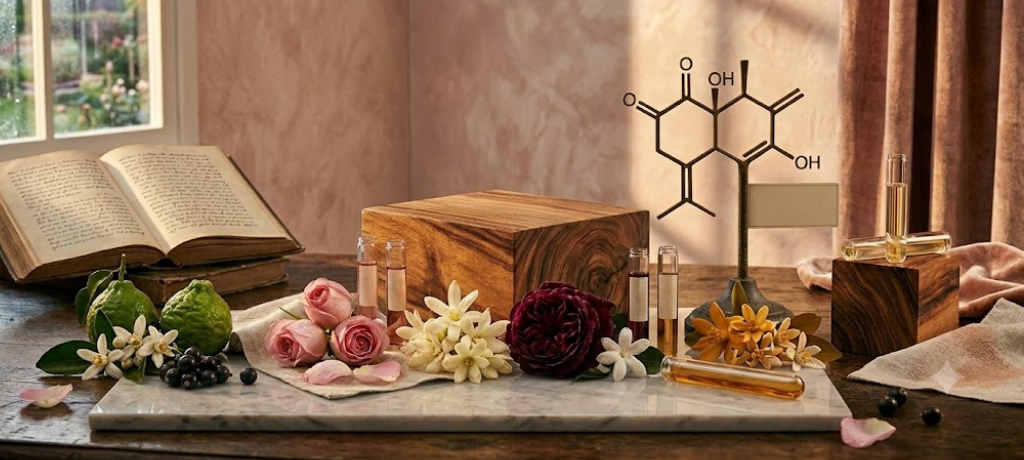
Floral fragrances dominate mainstream perfumery for a reason. Flowers are one of the oldest and most universally understood forms of beauty, and perfumers have been working with their accords for centuries.
The classic florals — rose, jasmine, tuberose, orange blossom — each carry their own character. Rose moves between dewy and fresh at one end and dense, almost jammy, at the other.
Jasmine carries a depth that borders on intoxicating, the kind of scent that fills a room at dusk without announcing itself. Orange blossom sits at the edge of the family, honeyed and warm, bridging floral and fresh.
Flower Garden lives in this territory. Its opening of orange blossom, bergamot, and blackcurrant is the bright, confident version of floral — not heavy, not sweet, but present. It is the fragrance for the morning that should feel intentional.
The family splits between fresh florals — bright, daytime, easy — and powdery florals, which carry a dressed quality that feels more deliberate. For evenings where you want to be noticed without being loud, floral over sandalwood is one of the most enduring combinations in modern perfumery.
Scent of Dunes · Collection Finder
Build Your Perfume Collection
Every collector's shelf tells a story. Answer ten short questions about what draws you in — the moods, the memories, the notes you reach for — and we'll curate the fragrance family your collection should be built around.
10 questions · about 2 minutes
No right answers — just instinct. We'll reveal your personal collection notes at the end.
Almost there
One last thing — what's your name?
We'll use it to personalise your collection.
Top Notes
Heart Notes
Base Notes
Woody — depth, structure, and the scents that last
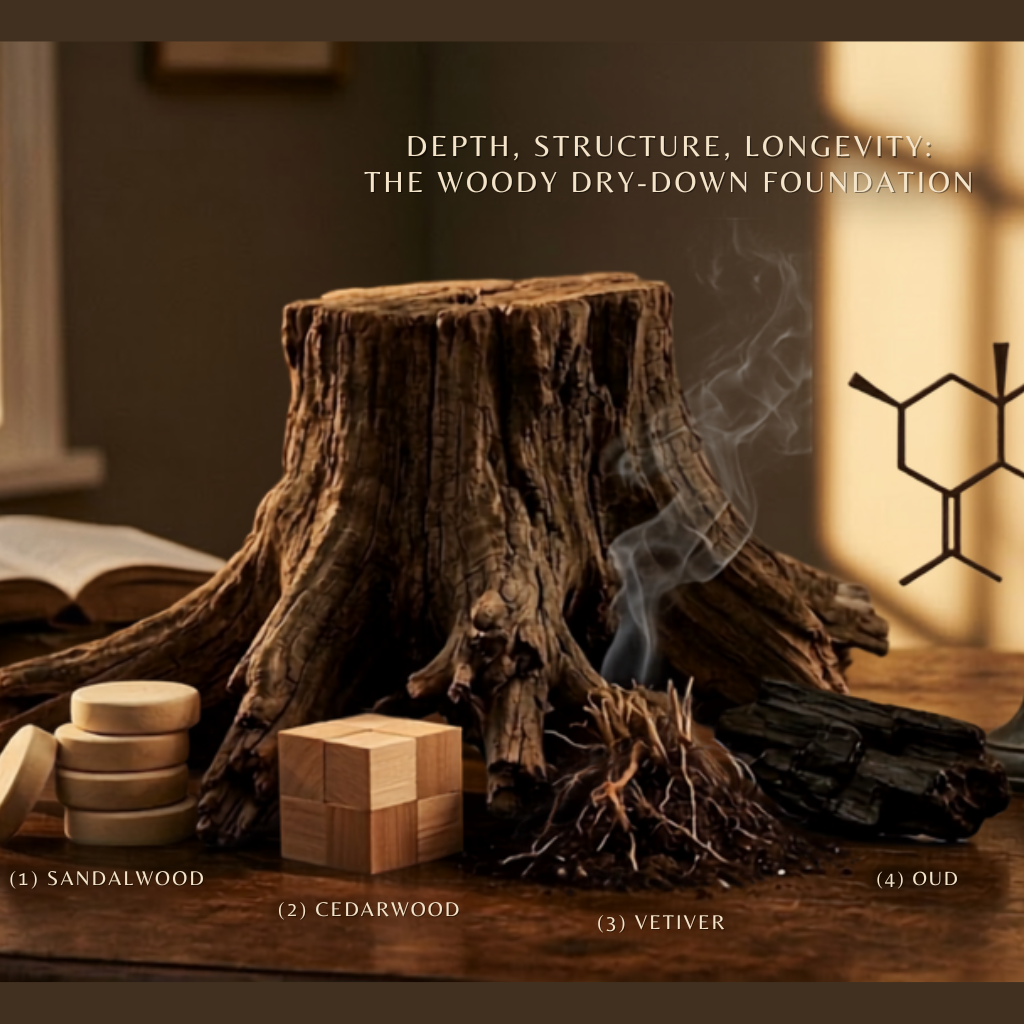
Woody fragrances build warmth.
They are what you smell in the dry-down of most serious compositions — the foundation that stays after everything volatile has burned off.
The four pillars are sandalwood, cedarwood, vetiver, and oud.
- Sandalwood is creamy and smooth.
- Cedarwood is dry and precise. Vetiver is earthier — smoky, slightly bitter, unmistakably itself.
- Oud is the heaviest, resinous and ancient, the material that anchors the great Middle Eastern perfume tradition.
What matters technically is molecular weight.
Woody materials evaporate slowly, which is why they dominate the dry-down and extend the life of whatever sits above them.
A composition without a woody base is like a building without a foundation — beautiful briefly, then gone.
Woody fragrances earn their keep in cooler months and in evenings where depth reads as presence rather than heaviness.
Spin The Wheel
Everyday Factors That Alter Perfume
Spin to discover how everyday environmental elements slowly change your favorite fragrance's composition over time.
Factor
How It Affects Your Perfume
Amber — warmth, sensuality, and the long evening
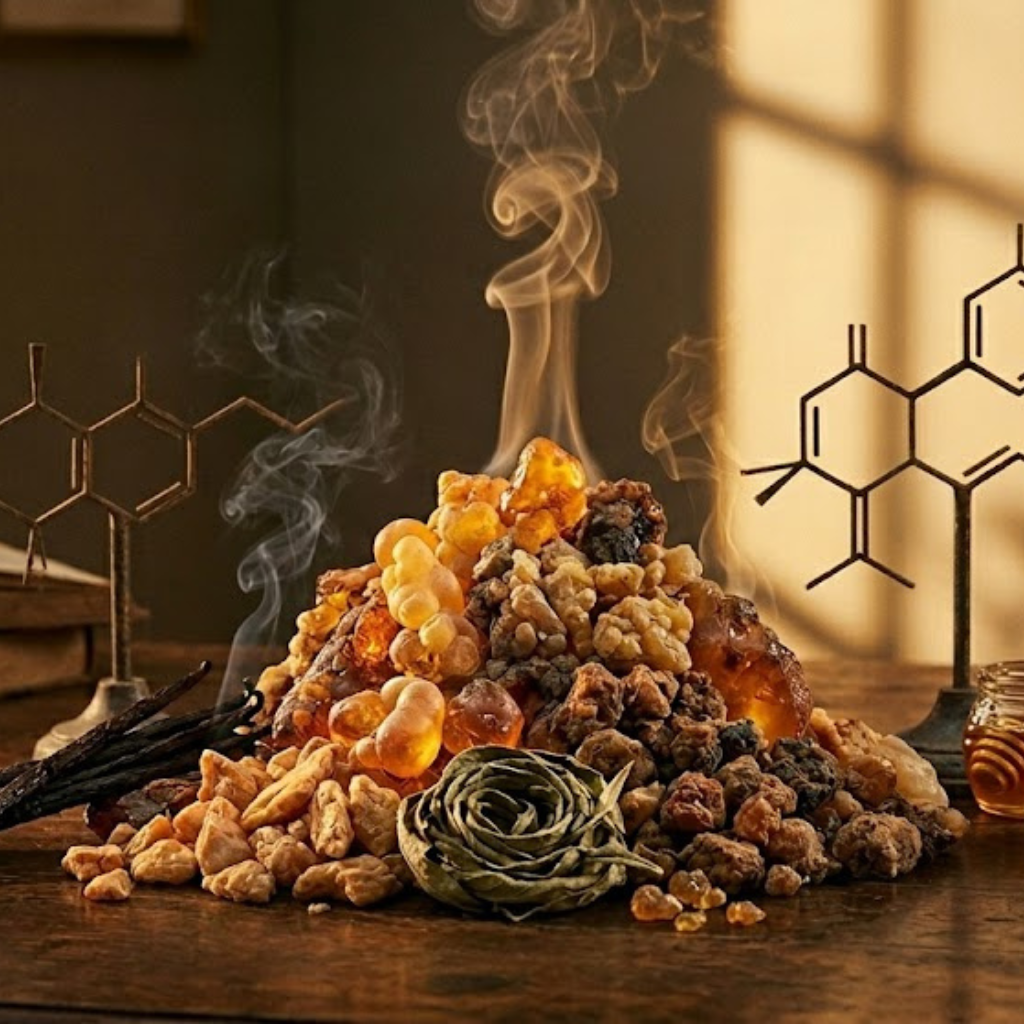
Amber fragrances are built for impact. Warm, rich, resinous, and unapologetically themselves — the family that projects farthest, lasts longest, and asks the most of whoever is wearing them.
The materials are vanilla, labdanum, benzoin, frankincense, myrrh, and the deep resins that give the family its signature warmth.
Amour Eternel sits here, built around oud, rose, and honey — the richness of amber softened by the romance of floral, with a depth that reveals itself slowly over hours.
It is not a fragrance for the background. It is a fragrance for evenings that mean something.
The lesson amber teaches is restraint. Two sprays of a well-built amber is enough for a dinner.
Three will fill the room. The projection is an asset in open air and an intrusion indoors. Learning to wear amber well is learning to trust that less is doing exactly the work you need it to.
Fresh — brightness, ease, and the intelligence of lightness

Fresh fragrances are often underestimated by people who equate longevity with quality. That equation is wrong.
The family covers citrus, aquatic, green, and aromatic — all sharing a quality of immediacy, a brightness in the first hour that other families cannot replicate.
Aromatic Wood opens with lavender, basil, and neroli: clean herbs over a bright floral note, the aromatic sub-family at its most considered. Valour takes a different angle — citrus and pimento with lavender underneath, a fresh fragrance with just enough spice to give it character. Both wear with the ease the family is known for, without sacrificing intention.
For anyone living in a warm climate, fresh fragrances are not a compromise — they are the intelligent choice. Heavy ambers that feel perfect in a cool evening can become suffocating on warm skin in humid heat. A well-built fresh fragrance on a Lagos afternoon in March will do more for you than any extrait reaching for gravity it cannot hold.
Scent of Dunes · Occasion Finder
Find the Perfume for Your Occasion
The right fragrance should match the moment, not fight it. Tell us where you're headed and what you're wearing, and we'll match the notes that belong there with you.
12 questions · about 2 minutes
Think outfits, settings, moods — we'll do the matching.
Almost there
One last thing — what's your name?
We'll use it to personalise your matches.
Most fragrances you will love live between families
The four-family system is a map, not a verdict. Contemporary perfumers work at the edges — floral notes over woody bases, amber richness opened with citrus brightness, clean aromatics anchored by something deeper underneath. Most of the fragrances worth exploring sit somewhere between two families, using each to temper the other.
The places where families blur are where perfumers do their most interesting work. A fragrance that sits cleanly in one box is often one made to please everyone. A fragrance that lives at the edge of two is usually one made with a specific person in mind.
Finding your family
The shortest path to understanding your own preferences is to look at what you already love and trace it backwards. If there is a fragrance you return to consistently — the one that feels most like yourself — it belongs to a family, and that family is telling you something about your taste.
From there, the next purchase is not a gamble but a conversation. You know the territory. You know which direction to move in, which to save for a different season, a different occasion, a different version of the evening you are planning for.
Fragrance families do not constrain the experience. They clarify it — giving you a vocabulary for something you already felt but could not quite name.