
Every fragrance format comes down to two things: how much oil it contains, and how that oil is delivered to your skin.
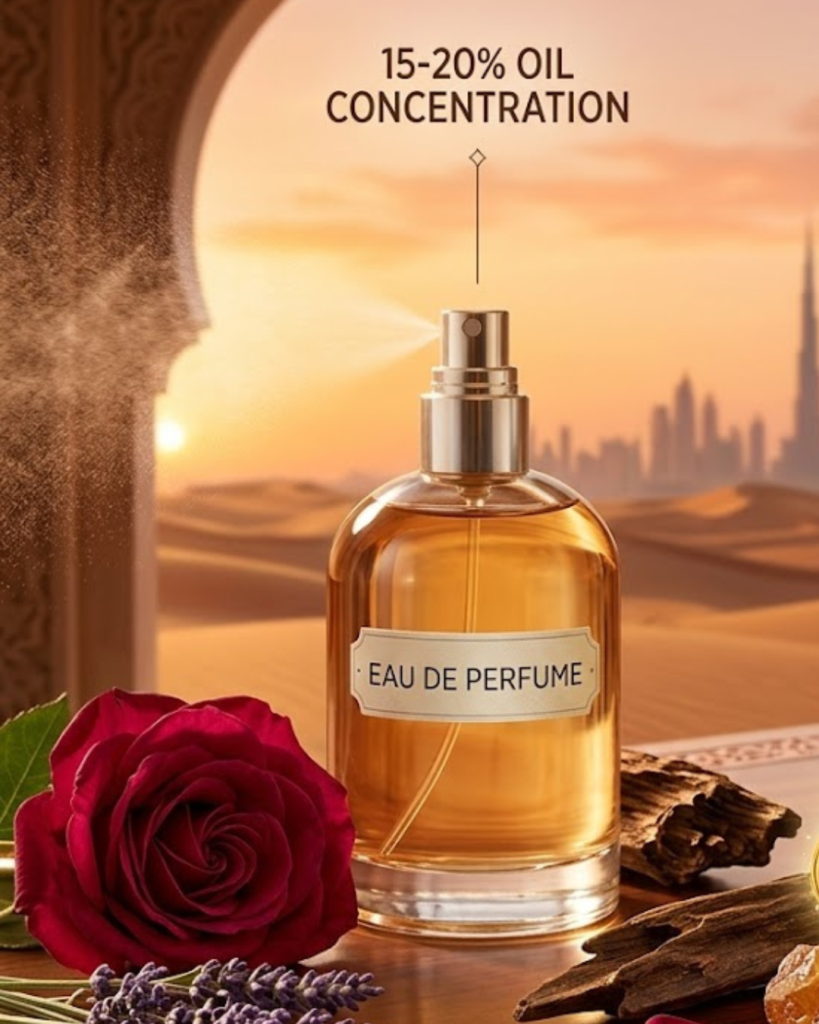
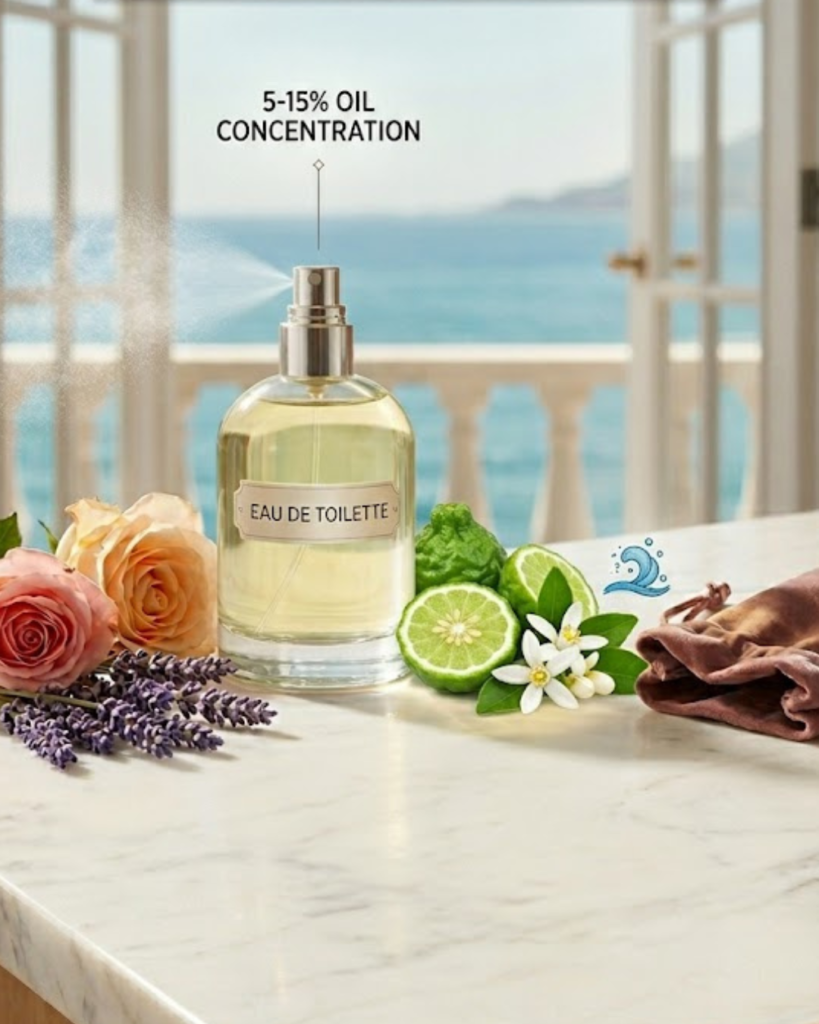
Eau de parfum carries between 15 and 20 percent fragrance oil, suspended in alcohol. Eau de toilette sits lower, typically between 5 and 15 percent, with a higher ratio of alcohol doing the lifting.
Perfume oil removes alcohol almost entirely, suspending the composition in a carrier — fractionated coconut oil, jojoba — that moves differently against skin.
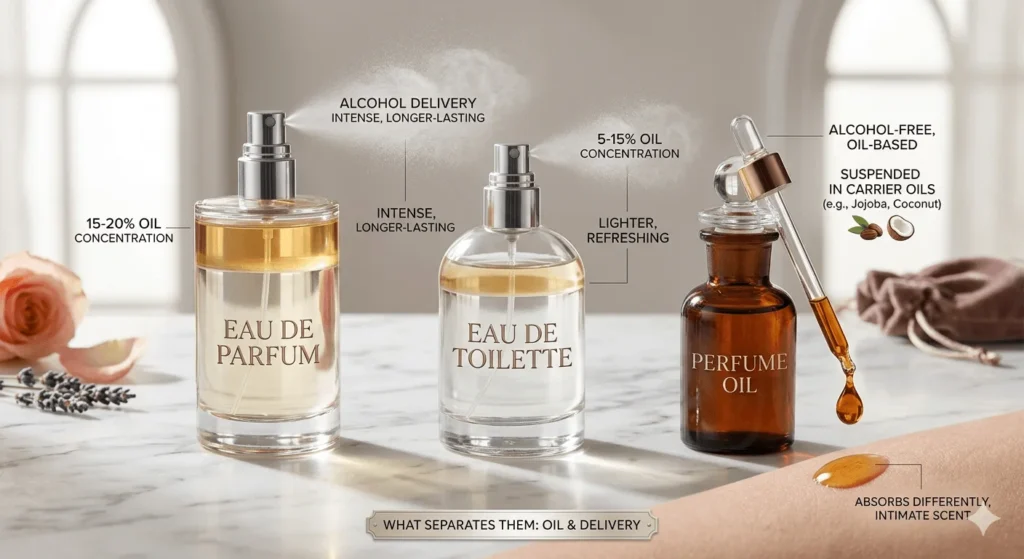
Here is what matters in EDT EDP Perfume Oil
Alcohol and oil do not behave the same way once they touch you. Alcohol evaporates fast.
It pushes the fragrance outward, away from your body, in those first few minutes after application.
Oil evaporates slowly. It holds the scent close, lets it breathe at its own pace, and keeps it intimate.
A rich extrait can open quieter than a lean EDT for the first hour, then outlast it by six.
Stronger is not always better.
Loudness at the wrist is useful in some situations and intrusive in others.
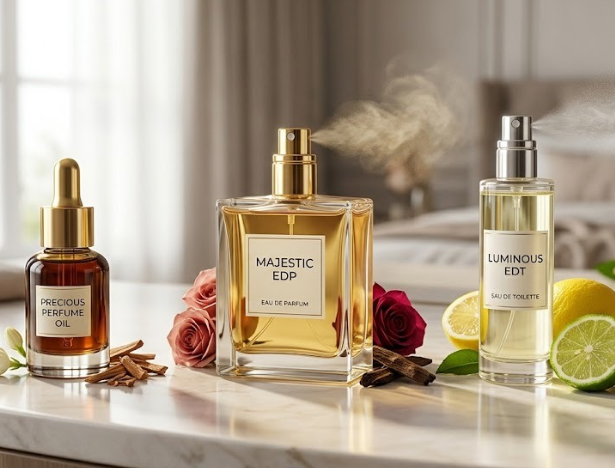
The question worth asking is not which format is most powerful, but which format suits what you are actually doing with your day.
When EDP is the right choice
Eau de parfum is the format that balances projection and staying power better than anything else, which is why most serious fragrance houses now lead their releases with an EDP.
The oil ratio is high enough to slow evaporation, giving you a strong presence in the first few hours, then a quieter but persistent dry-down that can carry you well into the evening.
Think of EDP as the format for occasions that ask something of you. A dinner where arrival matters.
A meeting where you want to be remembered without being noticed. A rainy evening where the warmth of the room draws out the deeper notes.
It rewards restraint — two or three sprays on pulse points are genuinely enough. More than that and you have moved past presence into intrusion.
One thing worth knowing: the percentage on the label does not guarantee performance.
A well-built 12 percent EDP from a house that sources quality materials will outlast a careless 20 percent formulation.
Composition matters as much as concentration.
Skin chemistry adds another layer — drier skin releases fragrance faster, and the same bottle will behave differently on two people standing in the same room.
Fabric holds fragrance differently than skin, too. An EDP sprayed onto the collar of a wool coat in October will still be there in the afternoon.
That is not a trick — it is simply how fibres bind to oil.
What you smell at 8am and what you smell at 6pm will have shifted, the top notes long gone, the base settled into something rounder and warmer.
That is the fragrance doing exactly what it was designed to do.
When EDT is the right choice
Eau de toilette is built for lightness. The higher alcohol ratio creates an opening that is immediate and bright, then softens quickly into something close to the skin.
That arc — vivid, then gentle — is the point, not a limitation.
Citrus, aquatic, and green compositions are almost always released as EDTs because the materials themselves are volatile by nature.
Bergamot, neroli, marine accords: they move fast and they lose intensity in any format.
Keeping them in an EDT preserves the brightness instead of burying it under base notes that were never meant to carry the composition.
Lagos in February is not Paris in October.
Heat accelerates everything — top notes burn off faster, heavier accords become overwhelming, and what felt balanced in a cool room becomes suffocating on warm skin. In hot weather, EDT is not the compromise.
It is the correct choice. The fragrance that reads as effortless in heat is usually the one that was built for it.
EDT is also the format for layering, for casual days, for the gym bag, for travel.
A quick reapplication after lunch is not an admission of weakness — it is simply working with the format rather than against it.
When perfume oil is right choice
Perfume oil asks something different of the person wearing it. Without alcohol to push the scent outward, everything becomes more personal. Someone close to you will notice it.
A room will not. That is not a disadvantage — it is, for many occasions and many people, exactly the point.
The mechanism is straightforward. Alcohol carries fragrance into the air. Oil holds fragrance against the body.
Remove the alcohol and you lose the dramatic opening blast — those first ten minutes of immediate presence — but you gain a wear that evolves slowly across the day and can last twelve hours or more on the right skin.
The base notes, which alcohol tends to push to the background early, come forward. The heart of the composition gets more time to breathe.
The Middle Eastern attar tradition understood this centuries before the modern perfume industry caught up.
Oil was never a lesser format. It was a different relationship with scent entirely — intimate, layered, built to be discovered rather than announced.
For dry skin, oil is often the most practical choice.
Alcohol-based fragrances evaporate faster on skin that lacks natural moisture, which is why the same bottle performs so differently depending on who is wearing it.
Oil addresses that directly. A rollerball also travels well. It fits in a jacket pocket, survives a carry-on without drama, and reapplies discreetly.
For anyone who wears fragrance as a daily ritual rather than an occasional gesture, the practicality of oil is real.
Matching the format to the life you are living
The most common mistake in fragrance is not buying the wrong scent. It is overspraying the right one.
Three sprays of a well-built EDP are enough for most settings. Six will not make it last longer — they will make it harder to be near you.
The other habit worth building is rotation. A citrus EDT that feels effortless in summer can read as thin and cold in December.
A rich oud-based oil that felt perfect in January can become heavy on a humid afternoon. Treating one bottle as a year-round solution is a convenience, not a strategy.
The format you reach for in the morning should match where you are going, not simply which bottle is closest to hand. EDP for the evening that requires something of you.
EDT for the day that should feel easy. Oil for the moment that belongs to you and the person beside you.
None of them is stronger. All of them are different. And the one that fits your life will always outperform the one that merely fits your shelf.